cmc banner
Advocating for Connecticut's Maritime Industry
nav bar
about us
member services
transportation
smart growth
ports
deep water port notes
whats new
careers
stats and studies
our leadership
how to join
contact us


P.O. Box 188
Stonington
CT 06378
Fax: (888) 436-5413

ctmaritime@msn.com


Connecticut Maritime Coalition
is pleased to announce our newsletter
:

Deep Water Port notes
The News Portfolio of The Connecticut Deep Water Port Community
New London . New Haven . Bridgeport


For PDF versions of Deep Water Port notes, download here:

Deep Water Port notes . January (1st Qtr), 2012

Deep Water Port notes December, 2011

Deep Water Port notes November, 2011

Deep Water Port notes October (3rd Qtr), 2011

Deep Water Port notes September, 2011

Deep Water Port notes August, 2011

Deep Water Port notes July (3rd Qtr), 2011

Deep Water Port notes June, 2011

Deep Water Port notes May, 2011

Deep Water Port notes April (2nd Qtr), 2011

Deep Water Port notes March, 2011

Deep Water Port notes February, 2011

Deep Water Port notes . January (1st Qtr), 2011

You may also read our first issue of
Deep Water Port notes
January, 2011 here (scroll down)

Connecticut Determined Not to Let Deep Water Maritime Commercial Development Pass It By

The Connecticut Maritime Coalition has taken notice of a simple but potentially costly oversight that could hurt Connecticut’s economy considerably over the next 25 years — it has 3 of the 100 largest deep water ports in the United States; but to the state’s loss these maritime commercial assets are better than 60 percent underutilized!

IT WAS NOT EVEN a century ago that more than 90 percent of industrial raw materials and finished goods were delivered into Connecticut, and the New England states, by ship into ports—Stamford, Norwalk, Bridgeport, Milford, New Haven and New London. Small lighters delivering fuels-diesel, heating oil, gasoline, and kerosene—and barges, all the way up to ocean going freighters bringing food stuffs, finished and unfinished metals, imported goods and material.

Even as late as 1941 that was the case; World War II was prepared for, supplied and fought for with the indispensable aid of waterborne traffic through maritime trade and shipping.

In 1942 the Gold Star Bridge over the Thames River was built of beams and concrete, all delivered by ship.

But the construction of the interstate highway system beginning in 1954, movement of many plants and retail malls to suburban and even rural environments contributed to the shift from maritime shipping to the new expeditious use of 18 wheeled trailer trucks for transit and delivery to intermediate and final destinations of over 70 percent of the region’s goods.

Add to that economic environment the availability of cheap diesel fuels, deregulation of the trucking industry, and the heavy investment in state and federal highways — combined with the loss of investment in the U.S. maritime fleets and many ports filling up with silts, denying access to the newer, deep water draft freighters — some with four to five times the previous cargo carrying capacity of WWII style cargo ships.

A decade ago shipping, pier owners, and other maritime interests realized that Connecticut’s three major deep water ports (some now not so deep as major vessels would require) were an extraordinary and uniquely valuable asset whose time had
come again!

They joined together to contribute something to the state and region that would assist the broad spectrum of the state’s and regions’ economy—forming the Connecticut Maritime Coalition (CMC). They knew that goods and material flowing through Connecticut’s ports would make more economic sense—especially with diesel fuel now approaching $4.00 a gallon, and that price placed squarely in the public’s purchasing lap. Domestic shipping by sea—termed short sea shipping—where goods from places like Florida, Texas and South Carolina would get shipped by boat to Providence, New Bedford, Davisville, and the ports of New York and New Jersey, eventually ended up in Connecticut and Southern New England. They could have been shipped to Connecticut ports, but for the limitations on harbor and channel depth, pier facilities, rail head connections, and modern warehousing with material and cargo facility handling sufficient to the task.

The economic and business opportunities were there. Preparation to take advantage of it was CMCs assignment.

CMC Holiday Reception at Quinnipiac Club in New Haven

It was a festive mood at the Quinnipiac Club on Church Street in the port city of New Haven on December 8, as the CMC hosted its members in celebration of the Holidays. Executive director Bill Gash took the opportunity to gracefully but firmly encourage individual members to perform some industry outreach inviting new membership. It was at this event that revival of the organization newsletter was proposed.

The newsletter was suggested to play a useful and informed role in communicating to both the public and private sectors the critical need for deep water port development in New London, New Haven and Bridgeport, conveying the message in simple but reliable terms explaining key solid principals and advantages behind better maritime shipping through Connecticut; something that has gained real traction in neighboring NY, RI and MA.

Malloy Campaigned Early for State Port Development

Bill Gash, executive director of CMC, noted that governor-elect Dan Malloy had spoken out during his campaign for vigorous support of deep water port development in Connecticut and the economic benefits that can flow from such public-private sector investment. Gash confirmed, after inquiring of Malloy’s transition team, that the draft working papers concerning port development had been included in his policy development binders; the executive director assured DWPn that CMC would not fail to provide Malloy’s office with useful and sustained support of information toward continued work on real port development.

Legislation had been adopted several years back recognizing the usefulness of deep water port development along the entire Connecticut coast, but only authorized a “political sub-division entity” to encourage and assist in private sector collating of investment and resources to achieve port development. No bonding authority was given, nor was there any tool to allocate public resources, such as that used to build even bridges, state roads, or airport development. Housed in the Transportation Department, empaneled by public appointees, it gave no real foundation for the private sector to have a dynamic or legally significant role. The state auditors’ recent report considered the operation under the law “ineffectual” with extremely modest resources, and no real definitive charge to action.

Deep Water Port of New Bedford MA
Shows Example for New England

Federally assured dredging to 28' by the Army Corps of Engineers in the deep water port of New Bedford Massachusetts harbor, coupled with near firm contract commitments for wind farm development in Vineyard Sound, emboldened port director Kristen Decas to announce commercial port resurgence in this venerable old whaling port, still the number one fishing port in the US. Rail head improvements to the Northeast rail corridor and new warehousing facilities help complete the promise of over 3,000 jobs and millions of dollars in new revenues to the area. She saw partnerships with other deep water ports in neighboring states.


DEEPWATER NOTES

by Don Frost

This is the first of several articles by Don Frost about ports and their place in economic development. This inaugural article is meant to give a historic view of the development of ports in general.

PORTS ARE THE central connection point between surface modes of transportation (rail, road, water). Located close to rivers, which were the first highways of civilization, ports became the trading posts where populations grew. In historic terms ocean access came later. Early ports were the portals through which local agricultural products moved to regional population centers in return for goods of all kinds. In Connecticut, Southport, for example, was the onion capital of New England until after the Civil War.

The growth of port populations and the development of transportation also encouraged small scale manufacturing. As manufacturing grew and transportation infrastructure improved, manufacturing could be farther and farther from the port. This slow process has only been interrupted by some new technology or development, for example containerization or the US Interstate Highway System. Bridgeport, for example, had been an important manufacturing center and industrial port until the 19860s.
A more recent development, globalization, has redefined David Ricardo’s 1817 theory of “comparative advantage”, and has dramatically raised the importance of very large (a.k.a. – Mega or Hub) ports. As a result many historically great ports around the world are poorly located for 21st Century trade.

Over time population has filled the space vacated by manufacturing and raised the value of land. As a result it has compromised ports’ supporting infrastructure or competes with commerce for water access. Ships continue to grow in size so as to maximize transportation economies of scale as distances between markets increase. The limits are ports’ draft, the speed at which it can handle cargo and the ability of its surrounding infrastructure to rapidly move cargo. Time is important. Ships are most expensive when they are in port.

The Mega or Hub ports still provide some support to manufacturing. However, to be competitive in a hyper competitive global economy, manufacturing depends on accessible ports with land available for expansion, as well as quick access to distribution networks that connect to raw materials sources, other manufacturing centers and consumers (i.e.-population centers).
Port operations have always involved a trade-off between population, its quality of life and commerce needed for economic growth. Environmental sustainability has been added, and the “quality of life issues” now include the ability to move traffic through and around ports.

Mystic Seaport Features Tug Exhibit; Port of New Haven

Using “joy sticks” in realistic pilot house, visitors to the Mystic Seaport Museum can actually operate twin barge loads up the East River in New York harbor, under the Williamsburg Bridge, docking the commercial load shown on a large, very realistic video screen. Hazards of jutting piers and opposing marine traffic appear and must be dealt with.

The full building display also includes a detailed, life-like replica of the deep water port of New Haven; Santa Energy maintains comparable facilities in the deep water port of Bridgeport. Legislators and public officials would find this display to be particularly instructive; driving by the actual site does not lend itself to casual inspection or greater appreciation of the commercial opportunities for the state!

Cargo Volumes in CT Deep Water Ports Show Modest Increase

Recent economic studies suggest the vitality of Connecticut’s deep water ports: New London and Bridgeport for which regularly provide critical regional transportation for cars, trucks, passengers and goods as a significant part of those ports’ trade—and petroleum, crude materials and chemicals which make up a key part of commerce for the deep water port of New Haven.

New Haven, one of two home ports for petroleum shipping in Connecticut, had handled over 7.8 million short tons of petroleum products in 2009. That port also landed from ships some 944,000 short tons of crude materials, and chemical cargoes weighing 562,000 short tons in that year.

New Haven was responsible for over 50 per cent of the state’s water borne commerce into its three ports in 2008, but far less of a percent of the total commercial shipping into and out of Connecticut by rail, trucks on roads, and air shipments combined.

CMC Membership Includes Diverse State Maritime Interests

Organized in 2000, the Connecticut Maritime Coalition is a non-profit trade association advocating for Connecticut’s Maritime Industry. Our members include:

Briarpatch Enterprises, Inc.
Joseph Gilbert, 203.876.8923, hiddenemp@aol.com

The Bridgeport & Port Jefferson Steamboat Company
Frederick Hall, 631-473-0286, FHall@McAllisterTowing.com

Blakeslee Arpaia Chapman, Inc.
John Fucci, 203-483-2954, jfucci@BAC-INC.com

Buchanan Marine LP
Alyson Sato, 203-466-0484, asato@buchananmarinelp.com

Cross Sound Ferry Services, Inc.
Adam Wronowski, 860-443-7394, adam@longislandferry.com

Connecticut Maritime Association, Inc.
Donald Frost, 203-406-0106, dbfrost@optonline.net

Connecticut State Pilots, Inc.
Capt. Charles Jonas, 516-319-5069, cpjonas@optonline.net

Empire Fisheries, LLC
Joseph Gilbert, 203.876.8923, hiddenemp@aol.com

Gateway Terminal
Tom Dubno, 203-467-1997, tdubno@gatewayt.com

GZA GeoEnvironmental, Inc.
Dan Kinard, 860-286-8900, dan.kinard@gza.com

Interport Pilots Agency, Inc.
Captain Louis Bettinelli, 732-787-5554, loubett@optonline.net

Moran Towing Corporation
Aislinn Pitchford, 203-442-2800, aislinn@morantug.com

New England Shipping Company, Inc.
David Pohorylo, 203-467-2423, dpohorylo@newenglandshipping.com

New Haven Port Authority
Judi Sheiffele, Ex.Dir., 203-946-6778, JSheiffe@newhavenct.net

New Haven Terminal
Michael Vasaturo, 203-468-0805, vpusec@aol.com

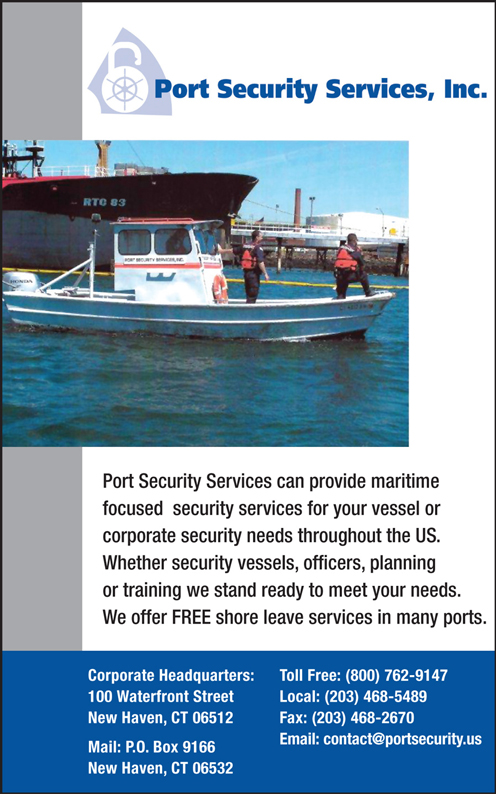
Port Security Services
Ralph Gogliettino, 203-467-1590, Ralph@portsecurity.us

Santa Energy Corporation
Thomas Santa, 203-362-3332, SantaT@santaenergy.com

Underwater Construction Corporation
James Swiggart, 860-853-8956, jswiggart@uccdive.com


DEEP WATER PORT notes is published quarterly by the
Connecticut Maritime Coalition, Inc, designated organizational
center for the Connecticut Maritime Industry Cluster.

The Connecticut Maritime Coalition's mission
is to advocate for Connecticut’s maritime industry.

To join the Connecticut Maritime Coalition,
or to advertise your business in Deep Water Port notes,
or for more information about the Connecticut Maritime Coalition,
please contact:

Mr. William Gash
Executive Director
Connecticut Maritime Coalition
P.O. Box 188, Stonington, CT 06378
Fax: (888) 436-5413
ctmaritime@msn.com

Return to Top